
Stay Connected
Sign up to receive our newsletter straight to your mailbox.

Thank you! Your submission has been received!
Oops! Something went wrong while submitting the form.


"Give me some coffee."
"I would like some coffee."
"Would you give me some coffee?"
Three similar sentences about coffee, but only one of them is a request.
The first is an order. The second is a desire said out loud — a fine thing to do, and it leaves the other person to work out what, if anything, you'd like done about it. Only the third one gives someone a choice they can answer.
Our relationships accumulate needless dissatisfaction as wants go unasked. A request turns a want into something another person can respond to, and surprisingly, most of us either never learned to do it well, or learned reasons to avoid it.
Behind every request is a desire, and behind that desire is a need.
A need is general. Sustenance, rest, connection, mattering. It isn't unique to you, which is why needs are what we recognize in each other even in the midst of other differences. A desire is what a need looks like when it points at something in particular: you need sustenance, so you want a snack, or you want to share a meal with a friend on Thursday.
A request is that desire made answerable: "Would you have dinner with me Thursday?"
And the answer is consent — granted or withheld.
A request is a desire made answerable.
Plenty of people make requests all day at work and freeze at the thought of asking for something personal. A task request serves the project or the business. A relational request — one whose fulfillment would satisfy you, or benefit your relationship — reveals a desire of your own.
Though the possibilities are endless, these fall into a set of categories shorter than you might imagine. Words of acknowledgment. Time spent together. Acts of service. Tangible things. Physical touch. That's Chapman's love languages, here as a menu of what you can ask for.
Some of these more directly serve the relationship itself: a conversation about your relationship so you can work something out, or establishing an ongoing expectation or commitment with each other. These conversations start best with a request that creates context: "there's something I'd like to talk about; do you have a few minutes?"
Making clear requests is where most of us stall. The chain begins on the inside: we feel the need; we sometimes name the desire, at least to ourselves. But the request is the link that connects us to another person. And that one either doesn't get made, or gets made sideways.
Expressing requests — the skill it takes to ask for what you want — has two parts. And the first happens entirely inside you: feeling your desire and knowing what you want. There's nothing real to say until you've got a handle on this part.
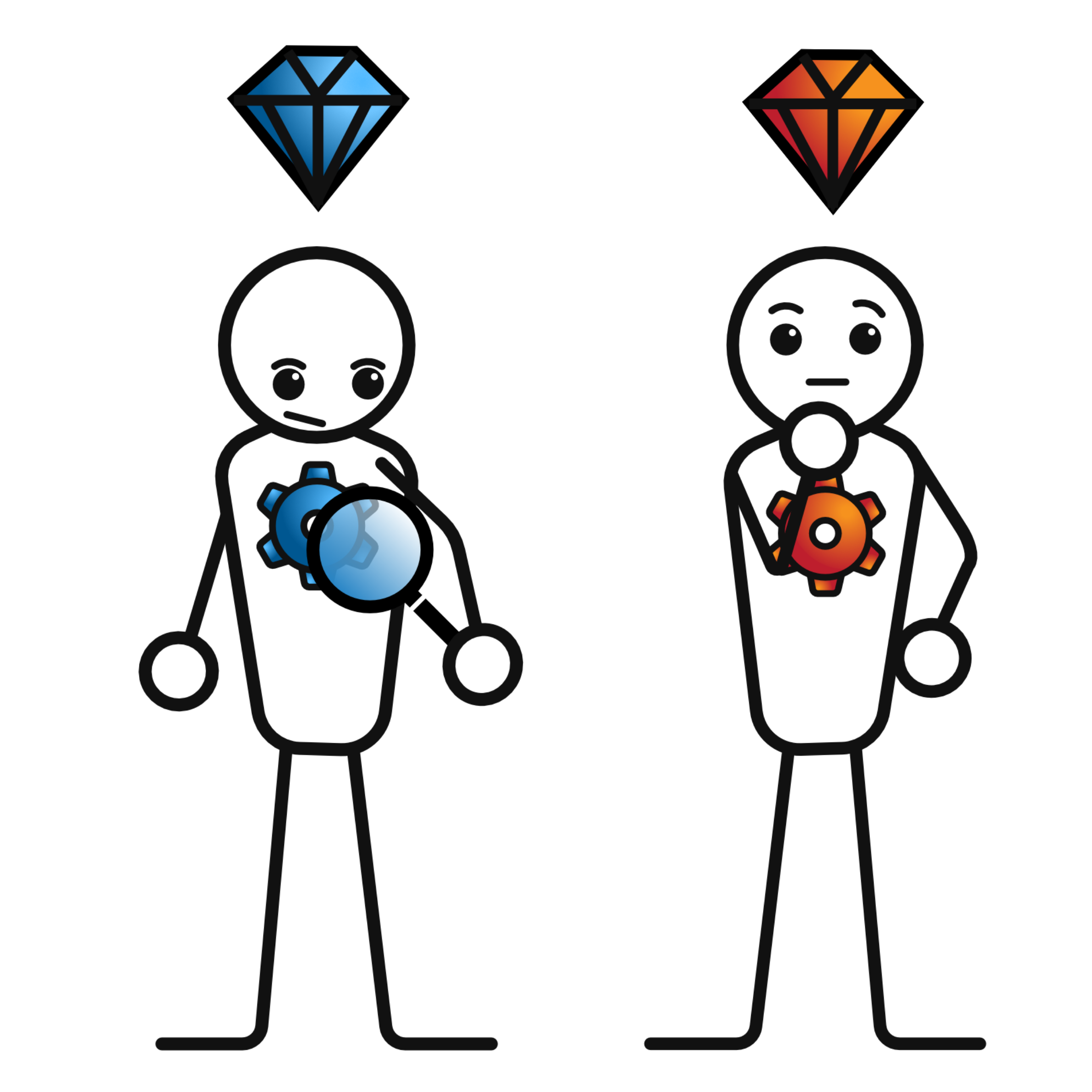
Sometimes you simply won't know what you want just yet. Taking a moment to sense yourself often clarifies it.
Sometimes it takes more. Some people find it consistently hard to know what they want, at least in a particular domain. This is often because somewhere along the way they learned that certain desires are forbidden, or because of difficult experiences that made wanting risky. Blocks like these typically require deeper exploration, the kind that happens with a counselor or therapist. They rarely yield to mere communication technique.
You can recruit your intimates to help you explore what you want with them, but this can be challenging and is best done in relationships with a lot of trust. This might sound something like, "I'm not exactly sure what I want, but I want to know what I want from you." This kind of communication carries risk, and is by no means required.
There's a subtler and far more common pattern: adjusting our desire downward before it's ever voiced, based on something we think the other person would be willing (or not) to do. Settling for less before even asking is like losing a negotiation with someone in your imagination.
That preemptive negotiation rests on a bad guess. When Francis Flynn and Vanessa Bohns studied direct requests for help, askers underestimated how often people would say yes by nearly half — we weigh the cost of someone's yes more heavily than that of their no. People are willing to help more than we imagine.
It can help to give yourself a moment to ask: what would I want if I could have it all my way?
You can trim it later. Start from what's true.
It leaks. It comes out as hints, as moods, as opinions delivered with extra weight, as complaints about a situation that would be fixed "if only somebody did something." These patterns are so easy to spot in others we've given them names like conflict avoidance and passive aggression.
Underneath them, usually, is one of a few beliefs. That a no would be too disappointing to handle. That it's unkind to put someone in a position where they might have to refuse. Or an idea so common it usually goes unquestioned: if they really cared about me, they'd know what I want without my having to ask.
That belief has a reasonable history. Our earliest caregivers did figure out what we needed before we could ask. Some people we've spent a lot of time with can get pretty good at anticipating our desires. There's nothing wrong with wanting that, or enjoying it when it happens.
It becomes a problem when not getting it starts to mean something about you: you don't matter enough. Or something about them: they don't care enough. Interpret it this way often enough, and it feels like more than disappointment. It becomes an identity.
The second part is saying your request aloud to the person. A request names something they can do — and know when it's done. It's clear when the other person can tell what they could do that would fulfill it. It's direct when it's phrased so they can answer with a yes or a no.
That phrasing makes room for consent. A yes-or-no question hands someone a real choice. A hint gives them nothing to answer.
Saying it plainly is where dignity comes in — the quiet regard that treats your own want as worth stating, without apology and without armor. Some forms that work:
You can always add please — as politeness, and as a small signal that you understand they have a choice.
Most requests need only a headline. "Would you shake my hand?" covers it. Add details when they'd matter to the person deciding: who else is involved, where, when, how. The reason usually goes without saying, except when your ask is unusual for your relationship, or likely to change it. Then the why matters most: revealing the desire or need behind the ask tells them what their yes would serve.
If someone at a dinner table says "I'd love a glass of water," they'll probably get one. Linguists call that an indirect speech act; it works because the table, the meal, and the company supply everything the sentence leaves out. Nobody issued any orders, which is part of why the dinner stays pleasant.
Cultures differ in how much they leave out: some of us grew up where asking for anything is fine and "no" is a normal answer — what writer Andrea Donderi named Ask culture (roughly, "low context"). Others grew up where you only ask at a point you're fairly sure the answer will be yes, and wants are met by offers, often without requests — Guess culture (roughly, "high context"). Both work beautifully among people who share them.
The trouble starts at the border. Ask and Guess misread each other, and — the part that surprises people — Guess cultures misread each other, because each runs on its own local dialect of implication. The same goes for the private shorthand two people build over years together: efficient, delightful, and not exactly useful beyond their relationship.
Still, learn the direct form. Not because indirect requests are worse — often they're both more efficient and warmer — but because the direct form is the one that translates. It's the version you can fall back on when shared context is thin, which is most of the time in a new relationship, a new team, or a text message.
You've made the ask. The other half belongs to someone else, and they have more moves available than yes or no.

They can ask a clarifying question or check their understanding before deciding: "so that I'm clear, are you asking me to…?" They can say yes, say no, or offer something else entirely: "what if instead, I…"
A counter-proposal is not a refusal. It's participation — the other person meeting your want with information you didn't have, usually about what they can genuinely give. Some great arrangements I've been part of started as somebody's alternative to what I originally asked for.
Receiving the answer is its own skill: receptive, responsive listening. It can be all too easy to bristle at anything that isn't the yes you wanted, like trying to debate them. Listen for the real yes or real no inside whatever they say; plenty of people have learned to decline so gently you could miss it. So whether it's a clear no or a subtle one, letting them know you've heard them builds goodwill for future requests.
And when it's a no, it's information, not failure. Maybe they're not ready, maybe they don't have it to give, maybe they need time. A no also closes one route to fulfilling a need, which can usually be served another way, by a different request or a different arrangement altogether. Meeting a no with respect for reasons that aren't yours requires a dose of humility: the same quiet regard you brought to the ask, now in response to their answer.
We can trust each other's yes in proportion to our willingness to hear the other answer. A yes that couldn't have been a no isn't worth much — it just tells you the person is agreeable, or tired.
The difference between a request and a demand is your willingness to receive a no. Marshall Rosenberg put that test at the center of Nonviolent Communication.
The difference between a request and a demand is your willingness to receive a no.
Sometimes a demand is obvious: a commanding tone, an ultimatum, the opening's "give me some coffee" with its unspoken or else. More often it's invisible until the moment someone declines, which is exactly when you find out what you were doing. Some signs: you believe the only acceptable outcome is their compliance, you feel they owe you, or you respond to the refusal by escalating — pleading, going cold, making the case again with more heat.
Demands tempt us because they often work in the moment. But they cost the relationship over time. You know how it feels when someone won't let you say no to them.
Power complicates the test. Hold more of it — manager, parent, the one who could make refusal expensive — and mere willingness to receive a no counts for less. Guessing wrong about it would cost them more than it costs you, and that tilts their read of you toward the safe response: compliance. The more power you hold, the more their no needs to be named as a real option, and made believable by your track record.

What a freely given yes makes possible goes beyond the moment. Some requests aren't for a single action at all: what you want is for something to be reliably true between you from now on.
That's a relational agreement: an explicit, ongoing, consensual commitment to take certain actions or hold certain limits, under conditions you both name. It sounds different from the start: "could we agree to…" rather than "would you…" That's the doorway between a one-time ask and the structure a relationship runs on. It's also how a boundary you hold alone becomes something you hold together: you ask someone to honor it, and the moment they explicitly agree, a commitment that was yours is now partly theirs.
Agreements deserve more discussion than I'm giving here. Two things to carry now. Write down the open-ended ones; human memory is not equal to the job, and a record spares you an argument about what was said. And expect them to be broken, by both of you, because you are both people. Repair isn't the sign an agreement failed — it's part of how one works.
Asking well doesn't guarantee you'll get what you want. It does get you an answer.
When you don't make requests clearly, you're left managing your disappointment in private and hoping someone notices. Making one puts something real between you: they know what you'd like, you know where they stand, and nobody's left guessing.
Asking well doesn't guarantee you'll get what you want. It does get you an answer.
You're unlikely to get what you don't ask for. And you can't be chosen by someone who was never given the choice.
